


Studying traffic rules, including road signs, is a mandatory requirement for every future driver. They help you navigate the road correctly and in a timely manner. Moreover, one of the most important topics is traffic warning signs. It is these signs that inform the driver about risks, potential hazards, and provide the opportunity to prepare for changing driving conditions.
The primary role of warning signs is to inform. They neither prohibit nor prescribe. Such signs merely warn about railway crossings, the appearance of pedestrians, intersections, dangerous turns, and other factors affecting traffic safety. Knowing them is a mandatory requirement both for passing the theoretical exam and for safe driving. A correct understanding of these signs helps avoid traffic violations and accidents.
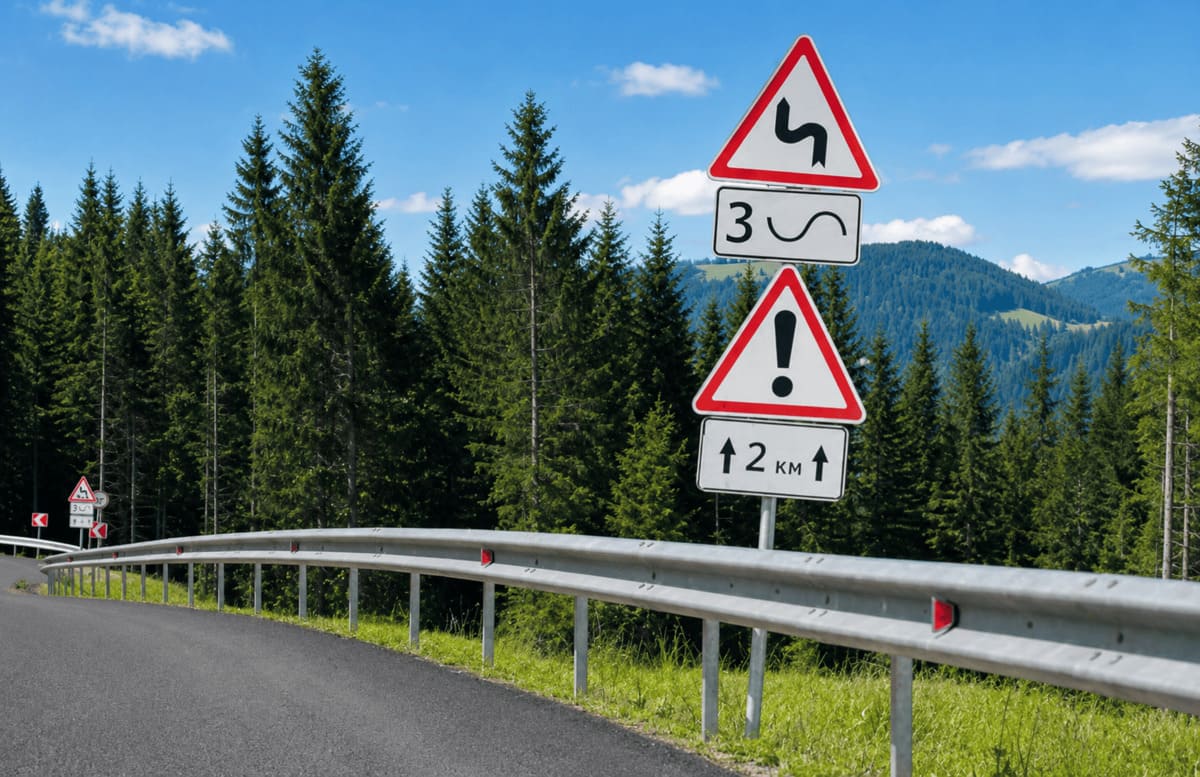
What are warning signs
This is the name for a specific group of signs that serve an informational role. They inform drivers about the approach to a dangerous section of the road or a change in driving conditions. Their main task is to warn road users in advance about potential risks and give them time to react safely.
For the most part, safety warning signs are triangular in shape. For motorists, they are made with a white or yellow background and a red border around the perimeter. This design allows them to be quickly recognized among other groups of road signs even from a considerable distance.
These signs are installed at a distance from the section they warn about. Thus, outside populated areas, traffic warning signs are usually placed 150-300 meters before the problematic section of the road, while in populated areas, they are placed closer – at 50-100 meters. This distance is sufficient for the driver to make a decision based on the information on the sign.
They are often installed together with plaques. These plaques clarify the distance to the dangerous section, its length, direction, or other important conditions. For example, they may indicate that road works begin in 200 meters or that the dangerous section extends for several kilometers. Therefore, while driving, it is important for motorists to pay attention not only to the sign itself but also to the additional information below it.
There is also a category of paired warning signs – they are present in almost every group and denote opposite dangerous situations. These include, for example, «Steep descent» and «Steep ascent», «Unmanned railway crossing» and «Manned railway crossing», etc.
Dangerous turns and direction of movement
This group includes signs in the 1.1–1.4.7 series. They warn the driver about sections where it is necessary to reduce speed, increase vigilance, and prepare to execute a maneuver:
- 1.1 «Dangerous right turn» - a triangular sign with a red border and a black curved line pointing right;
- 1.2 «Dangerous left turn» - a similar sign, but the curve points in the other direction – to the left;
- 1.3.1 «Multiple curves, first to the right» - this sign indicates a sequence of sharp turns, where the first one is to the right;
- 1.3.2 «Multiple curves, first to the left» - a similar sign warning of a series of turns, the first of which is to the left;
- 1.4.1-1.4.7 «Direction of turn» - these are rectangular signs with large arrows indicating the direction of traffic on sharp, small-radius turns or at T-intersections.
Such warning road signs in Ukraine are installed before road sections where there is an increased risk of losing control due to complex conditions. Upon seeing one of these signs, the driver must reduce speed in advance, be more attentive, and take the route's features into account.
.jpg)
To make it clearer, let's consider a common example. The 1.1 «Dangerous right turn» sign can often be seen in Kyiv. It is installed at certain exits from interchanges and on road sections near park areas where the turn has limited visibility or a small radius. Such a sign warns drivers in advance of the need to choose a safe driving speed and be ready for a change in the road's direction.
When studying this group of signs, it is important to pay attention not only to their number and appearance but also to the trajectory they indicate. This information allows you to recognize risks in a timely manner and avoid them, preventing hazardous situations.
Changes in road geometry
This group includes specific signs whose function is to inform drivers about changes in the width of the carriageway, certain terrain features, or other risks that may affect traffic. Knowing them allows you to reduce speed in advance, prepare for lane changes, and safely execute maneuvers.
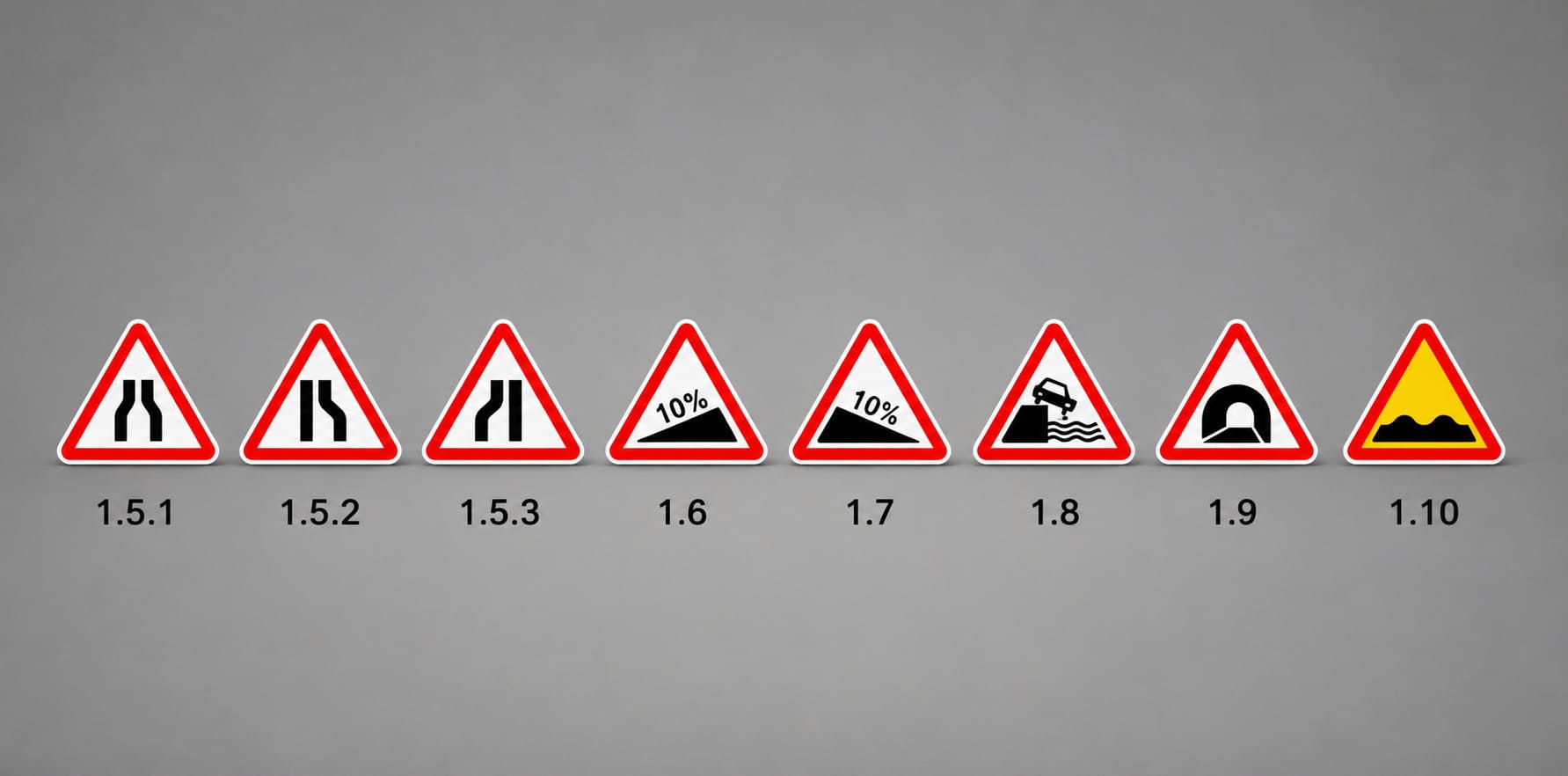
This group includes the following signs regarding changes in road geometry:
- 1.5 «Road narrows» - it depicts two lines converging towards the center;
- 1.6 «Road narrows on the right» - indicates that the width of the carriageway decreases on the right side ahead;
- 1.7 «Road narrows on the left» - informs that a narrowing is expected on the left side;
- 1.8 «Exit to embankment or shore» - this is a warning that the road leads to a body of water;
- 1.10 «Uneven road» - indicates that there is a section with an uneven surface ahead, which may negatively affect driving safety.
Driving school students who want to learn to drive and are studying traffic rules should not only memorize such signs but also learn their purpose. Each of them informs about changes in the road and carriageway conditions, so the driver's main task is to reduce speed in advance and increase attentiveness to react correctly.
Poor road surface condition
Potholes, ruts, bumps, or icy conditions in winter significantly worsen driving conditions for motorists and create hazards on the road. They negatively affect vehicle handling and can also lead to car damage and the occurrence of emergency situations. That is why it is worth knowing which signs can warn about this and learning to distinguish them:
- 1.11 «Bump» - this sign indicates road irregularities;
- 1.12 «Pothole» - informs about damage to the road surface;
- 1.13 «Slippery road» - warns that there is a section ahead where there is a risk of losing tire traction;
- 1.14 «Loose gravel». This sign indicates the likelihood of stones being thrown from under the wheels of other vehicles;
- 1.15 «Dangerous shoulder». Warns about a section that is best not to drive onto or stop on.
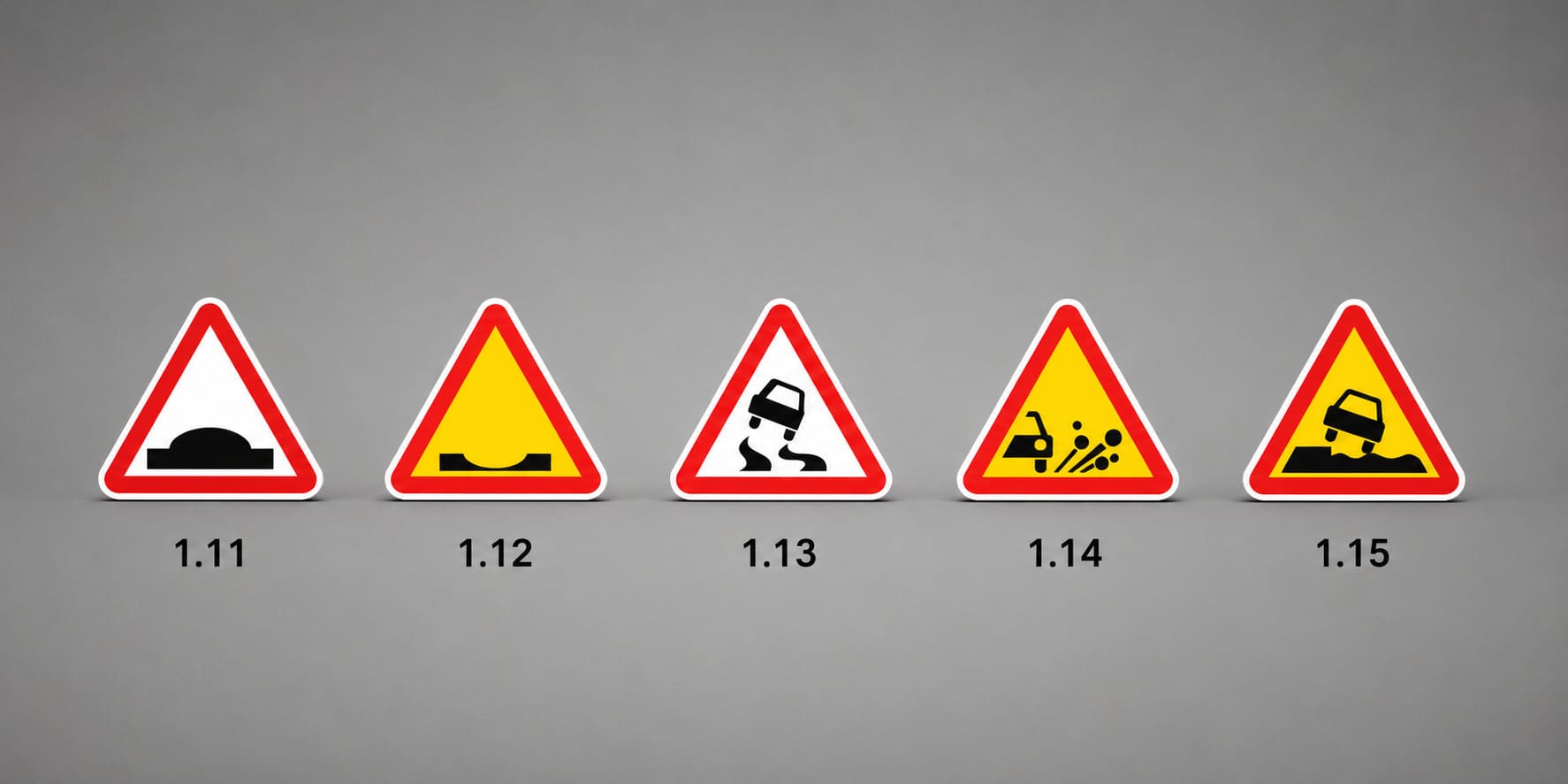
Signs in this group are triangular with a red border and feature characteristic graphic symbols that help quickly understand the type of hazardous situation. They are installed before problematic road sections so that drivers can orient themselves in advance, reduce speed, and increase the following distance from the vehicle ahead.
When preparing for the traffic rules exam, it is worth paying attention not only to the names of such signs but also to how the driver should act after seeing them, as this understanding will help you answer test questions correctly.
Intersections and road junctions
Signs in this group inform drivers about the approach to sections where traffic flows intersect. They belong to high-attention zones, as conflicts between drivers and collisions most often occur at intersections. Advance notification of such sections allows you to assess the situation in time, reduce speed, and concentrate on crossing it safely. This group includes the following signs:
- 1.21 «Intersection of equal roads» - informs about an intersection where the roads have equal priority;
- 1.22 «Roundabout» - indicates that there is a roundabout ahead;
- 1.23.1-1.23.4 «Junction with a minor road» - shows that there is a section ahead where a minor road will join from the right or left side;
- 1.24 «Traffic light control» - indicates that there is a pedestrian crossing or intersection ahead equipped with a traffic light;
- 1.25 «Drawbridge» - this sign is installed on the banks of bodies of water where there are bridges that can be opened for the passage of vessels.
All these signs also have a triangular shape, a white background, and a red border. After seeing them, you should carefully assess the traffic situation, pay attention to other road signs, road markings, and the possible presence of vehicles at the intersection. When studying the signs, it is worth learning the rules for crossing intersections right away to make it easier to navigate the road.
Bridges and artificial structures
Signs of this type inform drivers about the approach to engineering structures or road sections with complex terrain. Such objects can affect visibility, driving speed, and the execution of maneuvers without risks. These include:
- 1.18 «Exit to embankment or shore» - indicates that there is a body of water ahead and the road leads to the water;
- 1.19 «Road narrows» (near overpasses, bridges) – warns of a decrease in the width of the carriageway;
- 1.20 «Tunnel». Such signs inform that there are tunnels ahead, where visibility and lighting quality may differ;
- 1.6-1.7 «Steep ascent» and «Steep descent», respectively. Such signs indicate that the road gradient changes significantly ahead.
When preparing for the theory exam, it is important to know not only what the warning road signs in this group look like but also to understand what potential risks they denote. For example, in tunnels, due to limited space, changes in lighting, and the inability to stop quickly, the driver must maintain a safe following distance and control speed. And when driving over overpasses, bridges, or other artificial structures, weather conditions should be taken into account, as the effect of crosswinds is more pronounced in such areas.
Railway crossings
Such sections belong to high-hazard facilities. Usually, railway warning signs are installed near the crossing, and they indicate its type:
- 1.27 «Manned railway crossing» - indicates that there is a crossing with a barrier ahead;
- 1.28 «Unmanned railway crossing» - informs that there is a crossing without a barrier ahead;
- 1.29 and 1.30 «Single-track railway» and «Multi-track railway», respectively;
- 1.31.1-1.31.6 «Approach to railway crossing» - this is a group of additional warning signs that indicate the distance to the crossing.
Most signs of this type are triangular with a red border. The exception is the approach signs to the crossing, which serve as additional reference points and help drivers determine the distance to the hazardous section. They are rectangular in shape.
Road users
This is a separate group of warning signs. Their purpose is to inform drivers about the likelihood of other road users appearing on the road. These signs are installed in places where there is an increased probability of pedestrians, cyclists, children, or animals appearing, which may affect traffic safety:
- 1.32 «Children» - installed near places where children gather in large numbers: schools, kindergartens, sports grounds;
- 1.33 «Pedestrian crossing» - indicates an unregulated pedestrian crossing;
- 1.34 «Cycle route crossing» - informs about the likelihood of cyclists appearing on the carriageway;
- 1.35 «Cattle crossing» - indicates a place for the organized driving of livestock;
- 1.36 «Wild animals» - installed in places where wild animals may appear on the road.
After seeing such signs, drivers are advised to reduce speed, be more attentive, and be prepared for the sudden appearance of people or animals on the carriageway. This is especially relevant near educational institutions, in residential areas, parks, and outside populated areas.
When preparing for the traffic rules exam, it is important not only to memorize the appearance of these signs but also to understand what actions the driver must take after spotting them. The correct reaction to potential danger will help the motorist avoid emergency situations and ensure the safety of all road users.
Temporary and operational hazards
If the hazard on the road is temporary, such as one caused by repair work, warning signs are also installed according to traffic rules:
- 1.37 «Road works» - indicate that construction or repair work is being carried out on the section;
- 1.13 «Slippery road» - installed during icy conditions;
- 1.39 «Other dangers» - informs about possible risks that do not fall into the categories of other signs.
Usually, such signs are installed with plaques that clarify the type of hazard, the length of the difficult section, or the distance to it. This is discussed in more detail in the driving courses in Kyiv offered by the «PilotAuto» school, where all types of road signs are necessarily studied during theoretical classes. An important reaction for a driver when seeing such signs is to reduce speed, increase the following distance from other vehicles, and concentrate more on the traffic situation, which will allow them to predict it in a timely manner and take the correct actions to reduce risks.
Finally, it is worth noting that everyone needs to know warning signs. That is, not only drivers or driving school students who plan to get a driver's license. Warning signs are also needed for pedestrians, as they help them navigate the traffic situation and take care of their safety in advance, adjust their route, etc. You can even learn them on your own, while future drivers and driving school students will definitely study them as part of the theoretical course and exam preparation. Knowledge of warning signs will help avoid emergency situations and travel safely in any road conditions.
